Solutions · Custom contracts
Custom contracts
without custom code.
Write the deal you signed as a contract in Limitr Cloud. Its prices, limits, and terms reach every engine on the next call.
- Customer
- Acme Corp · Pro
- Term
- 2 years from Jan 1, 2027
- Included
- 30M tokens a month
- Overage
- $38 per 1M, never blocked
- Ceiling
- $2,000 a month in overage
- Add-on
- Audit log, from Enterprise
The problem
Every big deal becomes
a branch in your code.
A higher limit behind an if statement. A discount in a spreadsheet. A feature nobody turned off when the deal ended. Sales sold it, and engineering carries it until someone notices.
How it works
A contract is a rule
on top of the plan.
Keep the plans everyone sees. A rule changes what one customer gets: a higher limit, a feature from another plan, its own price, a ceiling on overage. Cloud assigns it from the contract and takes it off when the term ends.
chat30M tokens, soft24.1Mrule · acme_2027audit_logon—rule · acme_2027 (Enterprise)ssoon—plan · Proapi50k a day31.2kplan · ProLimitr Analyst
The Analyst drafts the deal
from the usage.
Give it the goal: a renewal at a margin, room to grow, a budget the buyer can sign. It reads the account's real usage, forecasts the term, and drafts the contract that hits the number.
Draft a two-year renewal for Acme at a 35% margin, with room to grow 50%.
- Included30M tokens a month · $1,400
- Overage$38 per 1M, ceiling $2,000
- Add-onAudit log
- Forecast margin35% over the term
What a contract holds
Every deal in
one policy.
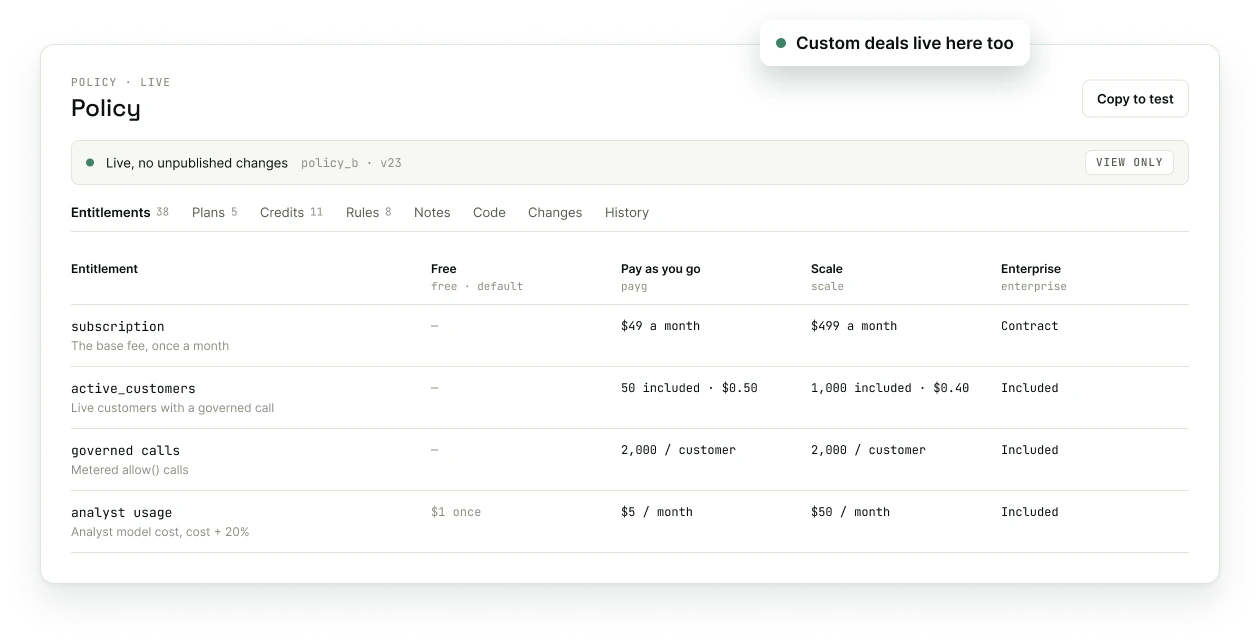
Plans and contracts live side by side, versioned and tested together, so a price change never breaks a deal and a deal never forks your plans.
Prices per customer
Its own price for a credit or a pack, a committed amount, a discount. Limitr Cloud puts it on the invoice.
Limits and ceilings
Higher or softer limits, a ceiling on overage, and budgets for every team under the account.
Terms with dates
Start, end, and renewal. When a term ends, the rule comes off and the plan takes over on its own.